

EZshoot 4-16x44 Scope Review: A Smart Budget Choice for Precision Shooting
Mar 24, 2026
Choosing a rifle scope can feel confusing, with specs like 4-16x44 and terms like “parallax” or “illuminated reticle” making it hard to know what you really need. This often leads to hesitation or buying the wrong scope.
This guide simplifies the key features of a 4-16x44 scope, helping you understand how to use it effectively—from close-range shooting to more precise mid-range shots.
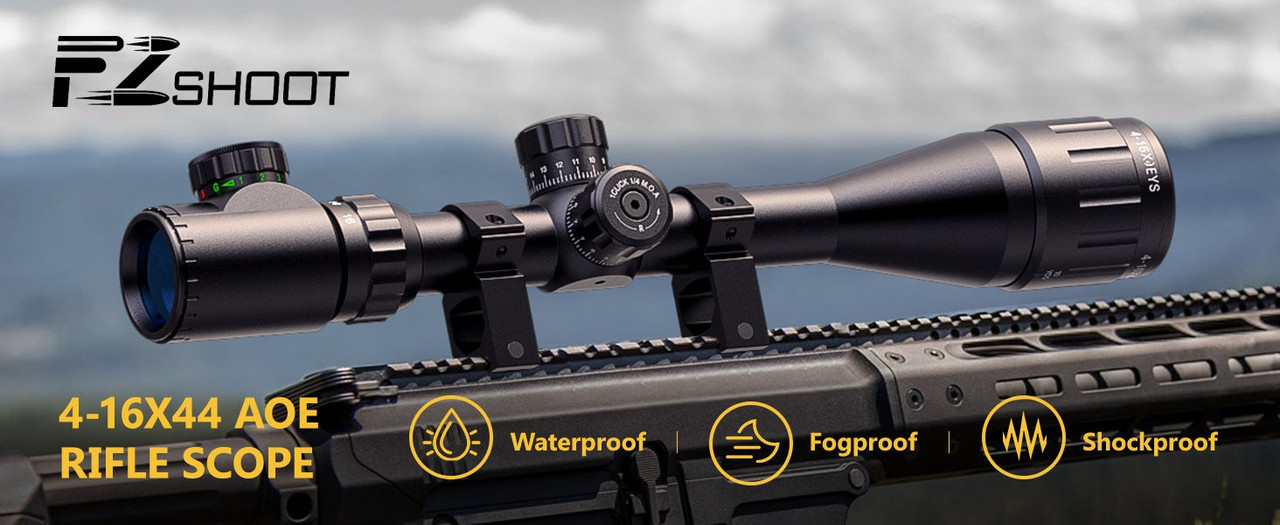
⚙️ Core Optics Concepts: What "4-16x44" Actually Means
Before we explore applications, it's crucial to understand the language of optics. The numbers on a scope aren't arbitrary; they are a direct measure of its performance and capabilities. Let's break down the fundamental components.
Magnification Range (4-16x)
This is the heart of a variable power scope. The "4-16x" indicates that the scope can magnify the image you see from a minimum of 4 times (4x) to a maximum of 16 times (16x) the power of the naked eye. This wide range is what makes the optic so adaptable:
- 🔴 Low Power (4x-6x): At this setting, you get a very wide Field of View (FOV)—the total area you can see through the scope. This is critical for situational awareness, scanning for targets, or engaging movers at closer distances.
- 🔴 Mid Power (7x-11x): This is a versatile sweet spot for general-purpose shooting and hunting out to several hundred yards. It offers a good balance between magnification for detail and a usable field of view.
- 🔴 High Power (12x-16x): Reserved for precision. At 16x, you can see fine details on distant targets, making it ideal for target shooting, varmint hunting, or confirming a target before taking a long-range shot.
Objective Lens Diameter (44mm)
The "44" refers to the diameter of the objective lens (the lens at the front of the scope) in millimeters. This is a critical factor for two reasons:
- Light Transmission: A larger objective lens can gather more ambient light. This directly translates to a brighter, clearer image, especially during the critical dawn and dusk hours when game is most active. A 44mm objective is an excellent compromise, offering strong low-light performance without the excessive bulk and high mounting requirements of 50mm or 56mm lenses.
- Exit Pupil: The exit pupil is the small circle of light you see in the eyepiece. Its size is calculated by dividing the objective lens diameter by the magnification (e.g., 44mm / 10x = 4.4mm exit pupil). A larger exit pupil makes it easier and faster to align your eye with the scope, a concept known as having a more forgiving "eyebox."
Parallax Adjustment (Adjustable Objective - AO)
This is arguably one of the most important—and misunderstood—features on a mid-to-high power scope. Parallax is an optical illusion that occurs when the target and the reticle are not on the same focal plane. If you move your head slightly while looking through the scope, the reticle will appear to shift its position on the target. This can lead to missed shots, especially at longer ranges.
⚙️ Technical Insight: Scopes without parallax adjustment are typically factory-set to be parallax-free at a specific distance (e.g., 100 or 150 yards). The side-mounted adjustment knob on a scope like the EZshoot 4-16x44 allows you to precisely focus the scope for the exact distance to your target, eliminating this aiming error entirely. For a detailed technical explanation, you can explore resources on understanding parallax from the NSSF.
🏹 Scenario-Based Performance: Putting the Scope to Work
A scope's value is not in its specifications, but in its real-world application. Here’s how a 4-16x44 optic performs across different scenarios.
Close to Mid-Range Flexibility (50-300 yards)
For many shooters, this is the most common engagement distance. At 4x or 6x, the scope functions almost like a high-powered red dot, allowing for rapid target acquisition on steel targets or in dynamic hunting situations. As you increase the distance, dialing up the magnification to 8x or 10x allows you to place shots with precision without feeling "over-scoped" and losing sight of the surrounding area.
Extended Range Target Shooting (300+ yards)
This is where the 16x magnification and parallax adjustment truly shine. When shooting at small targets at 300, 400, or even 500 yards, the ability to zoom in and see your target clearly is non-negotiable. More importantly, correctly setting the parallax for that distance ensures that your point of aim is your true point of impact. The clear turret markings for windage and elevation allow for repeatable adjustments, a key for dialing in your shots.
🔦 Low-Light and Challenging Conditions
Hunting and tactical scenarios rarely happen in perfect lighting. The combination of multi-coated lenses and an illuminated reticle provides a significant advantage when visibility is poor.
- Multi-Coated Lenses: Each lens surface is treated with microscopic coatings that reduce glare and reflection, maximizing the amount of light that travels through the scope to your eye. This results in a brighter, higher-contrast image.
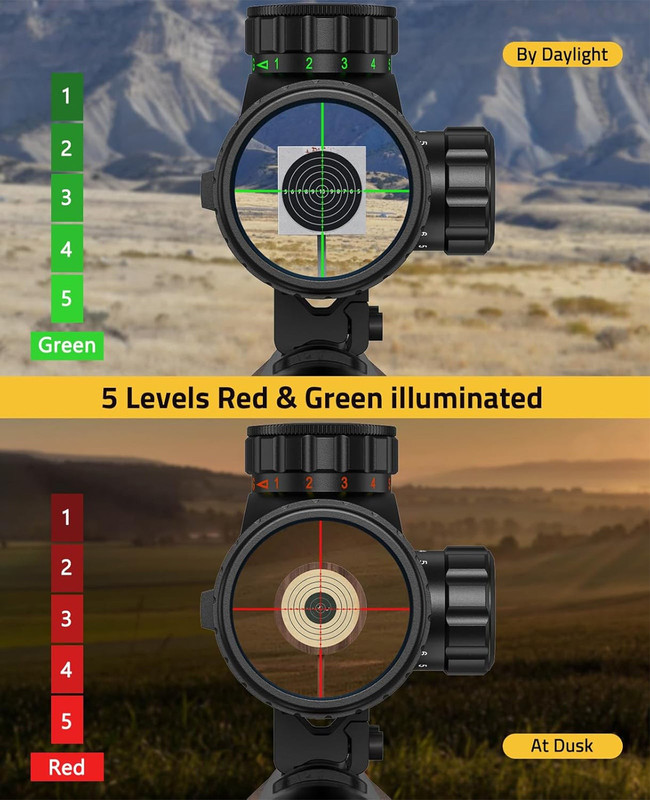
- Red & Green Illumination: In low light, a standard black reticle can disappear against a dark target or shadowy background. The illuminated reticle (available in red or green) makes your aiming point stand out. Red is often preferred for preserving night vision, while green can be more visible to the human eye against certain backdrops. Multiple brightness settings allow you to match the intensity to the ambient light, preventing a reticle that is too bright and "flares" in your vision.
What Actually Matters: A Practical Performance Breakdown
Beyond the numbers, three factors determine if a scope is a reliable tool or a liability.
- Optical Clarity: Can you see the target clearly from edge to edge? A quality scope provides a sharp, crisp image with minimal distortion or color fringing (chromatic aberration). This is a direct result of glass quality and lens coatings.
- Ability to Hold Zero: This is the most critical function. A scope must maintain its point of impact, shot after shot, even after absorbing recoil or being bumped in the field. This depends on robust internal mechanics and construction.
- Repeatable Adjustments: When you dial the turrets for wind or elevation, you need to trust that each "click" moves the point of impact by a precise, consistent amount (e.g., 1/4 MOA). Furthermore, you must be able to return the turret to its original setting and have your zero be exactly where it was. This is known as "tracking," and it's essential for long-range shooting.
Common Mistakes to Avoid
- Over-tightening Scope Rings: This is the number one cause of scope damage. Applying too much torque can crush the main tube, damaging internal components and voiding your warranty. Use a torque wrench set to the manufacturer's specifications.
- Ignoring Parallax: Many shooters leave their parallax set to 100 yards and forget about it. At 16x magnification, an incorrectly set parallax can cause misses of several inches at longer distances. Always adjust it for your target's range.
- Improper Eye Relief: Setting the scope too far forward or back can result in a partial sight picture or, more dangerously, "scope bite" from recoil. Set the scope at high magnification and adjust its position in the rings until you see a full, clear image without straining your neck.
Product Spotlight: The EZshoot 4-16x44 AO Scope
For shooters seeking a feature-rich optic that balances performance and value, the EZshoot 4-16x44 Illuminated Scope is engineered to be a versatile solution. It directly addresses the needs discussed above, making it an excellent choice for a wide range of firearm platforms.
Field Notes & Performance Insights
- Versatile Magnification: The 4-16x range proved highly effective, transitioning smoothly from wide-view scanning at 4x to precise aiming at 16x. The zoom ring operates with firm, consistent resistance.
- Clear Optics: The fully multi-coated lenses deliver a bright and surprisingly clear image for its class. Edge-to-edge clarity is solid, with good color rendition during daylight hours.
- Functional Illumination: Both red and green illumination settings are distinct. The lower brightness levels are perfect for dawn/dusk, preventing reticle flare and preserving the sight picture.
- Precise Parallax Control: The side-mounted adjustable objective is easy to use and effectively eliminates parallax from 15 yards to infinity, a critical feature for both airgunners and long-range rifle shooters.
- Universal Mounting: The inclusion of mounts for both 11mm Dovetail and 20mm Picatinny/Weaver rails adds significant value and ensures out-of-the-box compatibility with most rifles.
Frequently Asked Questions (FAQ)
What does 4-16x44 actually mean on a scope?
The numbers '4-16x44' describe the scope's core specifications. '4-16x' is the variable magnification range, meaning the image can be magnified from 4 times to 16 times its normal size. The '44' refers to the diameter of the objective lens (the one closer to the target) in millimeters. A 44mm objective lens offers a great balance of light-gathering capability and a relatively low mounting profile.
Will the EZshoot 4-16x44 scope fit my rifle?
This scope is designed for high compatibility and includes mounts for both 11mm (Dovetail) and 20mm (Picatinny/Weaver) rails. This covers the vast majority of modern sporting rifles, air rifles, and rimfire rifles. Always ensure your firearm has one of these two rail types before purchasing.
Conclusion: The Smart Choice for the Versatile Shooter
A 4-16x44 scope represents a powerful intersection of capability and practicality. It eliminates the need for multiple, specialized optics by providing the flexibility to handle nearly any shooting scenario you might encounter. From fast-paced action at close quarters to methodical, long-distance precision, its features are designed to enhance accuracy and build confidence.
By understanding the core concepts of magnification, light transmission, and parallax correction, you can move beyond the marketing jargon and make an informed decision. The EZshoot 4-16x44 AO scope is a prime example of this design philosophy, packaging essential, high-performance features into an accessible and reliable tool for the modern shooter.

